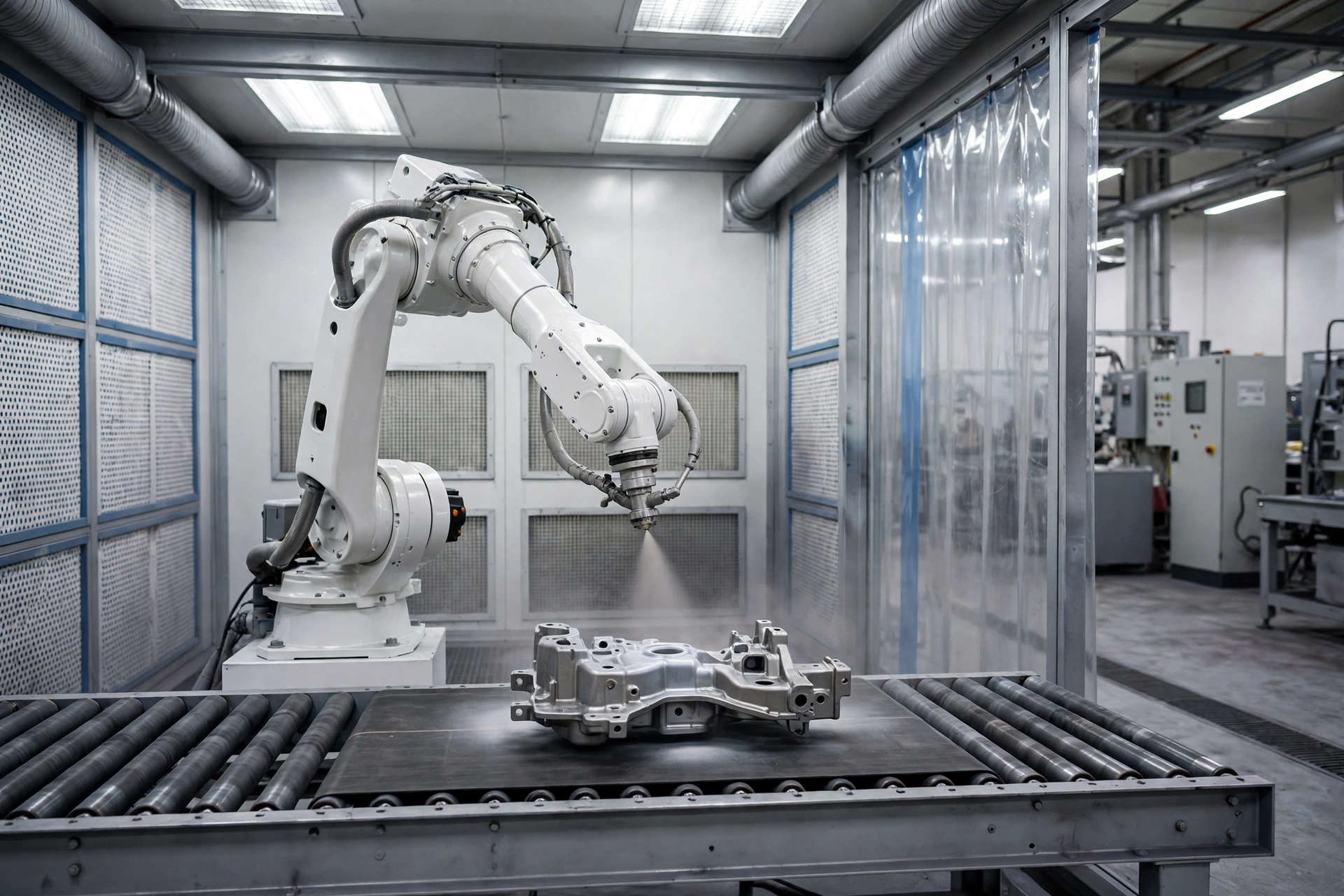
Robot parameters
The Kawasaki six-axis robot at the centre of this line configuration has a maximum load of 5 kg, a maximum working radius of 1000 mm and repeat positioning accuracy of plus or minus 0.2 mm. These are the robot unit's parameters; the line around it is configured separately. The line around it — booth, conveyor or rotary presentation, paint supply and curing — is configured to your parts and takt time.
| Parameter | Value |
|---|
| Axes | 6 |
| Maximum load | 5 kg |
| Maximum radius | 1000 mm |
| Repeat positioning accuracy | ±0.2 mm |
Line composition and integration inputs
A robotic line is only as good as its part presentation: fixtures must put every part in the taught position, every cycle. Mixed production works when programs are stored per part family and fixtures change quickly. Send part drawings, the number of families and your takt target; the proposal will state the cell layout and where operators load and unload.
Service and warranty
This equipment is supplied with a 12-month warranty. Spare wear parts (guns, nozzles, filters, belts) are listed in the quotation so you can stock them at commissioning.
Application scope
Robotic spraying serves parts whose geometry defeats fixed guns: deep-drawn trim, housings with recesses, doors with moulded profiles, sanitary ware and mixed families sharing one cell. The robot's taught path keeps gun distance and angle on surfaces that change orientation continuously, which is exactly where manual spraying varies most between operators and shifts.
A robot cell also changes the labour equation: operators load, unload and inspect instead of spraying, and exposure to paint mist falls. For factories facing painter shortages or strict exposure rules, that is often the deciding argument alongside finish consistency.
Teaching and changeover
A new part family needs a taught program and a fixture that presents the part repeatably; after that, changeover is a program call and a fixture swap. Teach time depends on part complexity, and it is spent once — which is why the business case improves with every family added to the cell. When you request a quote, list families in launch order so commissioning teaches the highest-volume parts first.
What to send for a configured quotation
- Part drawings or photos, with the largest part size (L x W x H)
- Coating type and finish requirements (colour, gloss, film thickness if specified)
- Required output: parts per hour or per shift, and working hours per day
- Destination country and local power supply (voltage / frequency)
- Workshop space available for the machine or line, if a full line is planned
Buyer questions
How many part families can one line run?
There is no fixed number; program storage and fixture changeover decide it in practice. List your families and launch order in the inquiry.
Not sure which configuration fits?
Send your part drawings, part size and output target. We will confirm the machine or line configuration and reply with a quotation.
Send an Inquiry