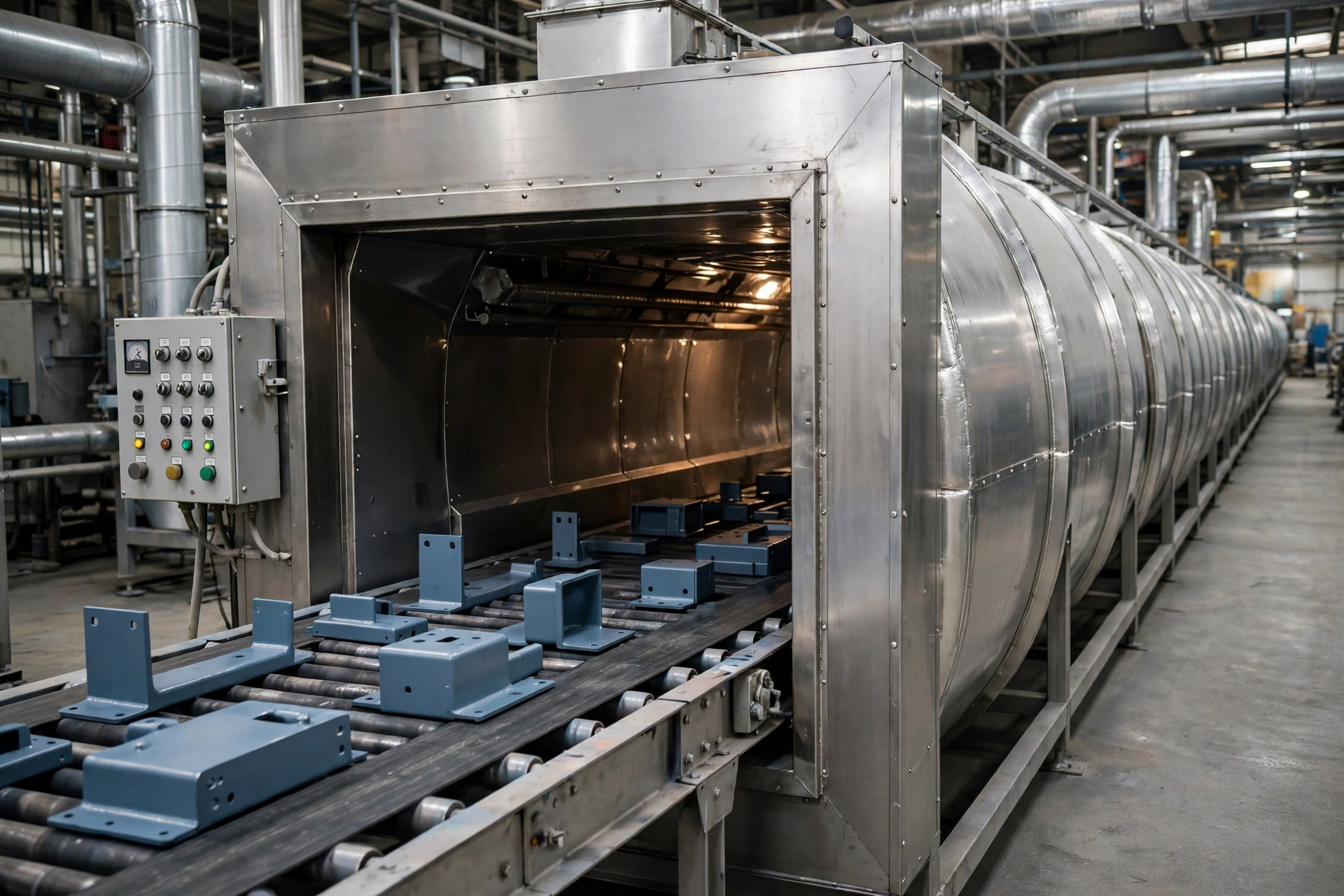
Tunnel ovens, box ovens and aging rooms compared
A tunnel drying oven belongs on a conveyor line: parts enter wet and leave cured at line speed. A box oven cures batches: racks or trolleys of parts are loaded, cured and unloaded, which suits mixed production and smaller volumes. Aging rooms hold parts at a controlled temperature for long, gentle cycles such as electronics aging tests. The right choice is set by your flow (continuous or batch) and by the cure schedule your coating supplier specifies.
| Equipment | Flow | Typical use |
|---|
| Tunnel drying oven | Continuous, on conveyor | Paint and powder lines at steady output |
| Box / multi-door oven | Batch | Mixed parts, racks and trolleys, smaller volumes |
| Aging room | Batch, long cycle | Electronics aging and heat treatment runs |
| UV curing furnace | Continuous | UV coatings (see the UV curing machine page) |
Matching an oven to a cure cycle
Send the coating supplier's cure schedule (temperature and time at temperature) and your part's heat tolerance. Heavy steel parts and thin plastic parts heat at very different rates, and the oven's hot-air circulation has to suit both the part and the coating. Oven temperatures are set from that cure schedule during configuration, so the oven is matched to your coating rather than to a catalogue default.
Application scope
Drying and curing equipment serves every coating type that does not air-dry at room conditions: baked enamels, powder coatings, adhesives and electronic assemblies on aging cycles. In a line, the oven is also the pacing element — its length and the conveyor speed set the maximum rate of the whole process, so oven sizing starts from your output target, not from the booth.
Batch ovens serve a different logic: they decouple spraying from curing, letting one booth feed several cure cycles or several booths share one large oven. Mixed production with several coatings often works better on batch curing, because each load takes its own schedule.
Energy and uniformity
Two specifications decide running cost and quality. Temperature uniformity across the load decides whether every part cures fully without overheating the nearest ones. Insulation and air recirculation decide fuel or power per batch. Both are configuration items: send your cure schedule and load pattern, and the proposal will state the uniformity the oven is built to hold.
What to send for a configured quotation
- Part drawings or photos, with the largest part size (L x W x H)
- Coating type and finish requirements (colour, gloss, film thickness if specified)
- Required output: parts per hour or per shift, and working hours per day
- Destination country and local power supply (voltage / frequency)
- Workshop space available for the machine or line, if a full line is planned
Buyer questions
Can I replace only the oven in my line?
Yes. Tunnel sections are built to your conveyor width and height. Send the line's cross-section dimensions and your cure schedule.
Which fuel or heating type should I choose?
Electric, gas and diesel-fired options exist across the range. The choice usually follows your site utilities and running costs; tell us what is available at your plant.
Not sure which configuration fits?
Send your part drawings, part size and output target. We will confirm the machine or line configuration and reply with a quotation.
Send an Inquiry