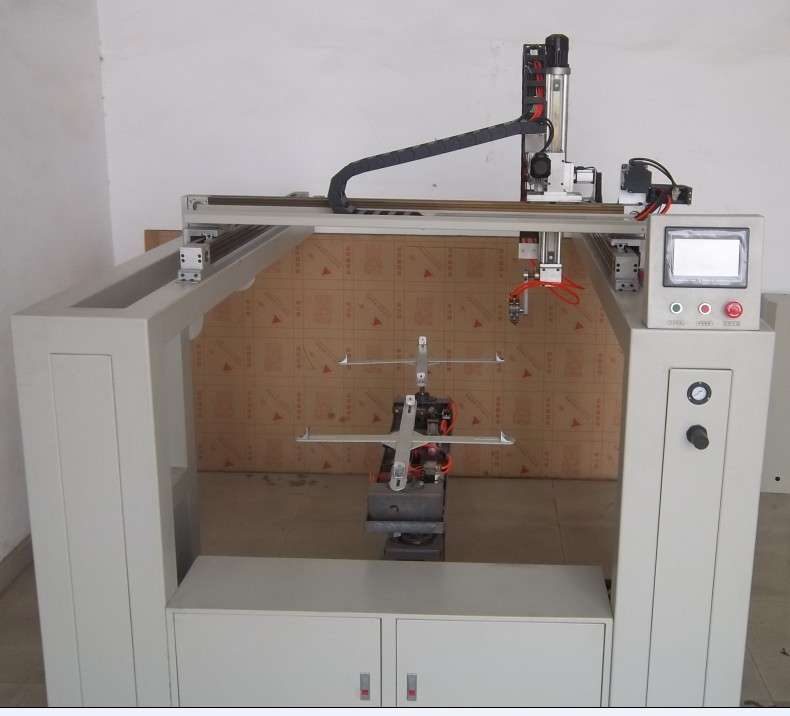
Compare the machine types
A single-axis machine moves the gun back and forth over flat parts. A three-axis machine adds vertical and depth movement for simple three-dimensional parts. Five-axis and six-axis machines add gun angling and rotation, which keeps the gun at the right distance and angle on complex housings, doors and moulded parts. Reciprocating machines carry the same back-and-forth motion onto a conveyor line, and mini rotary machines turn small parts under a fixed gun for short runs and trials.
| Machine type | Gun motion | Best-fit parts |
|---|
| Single-axis | Reciprocating stroke over the part | Flat panels, glass, boards, simple flat parts |
| Three-axis | X / Y / Z movement | Phone and hardware parts, simple 3D shapes |
| Five-axis | X / Y / Z plus gun tilt and rotation | Plastic and metal housings, laptop shells, helmets |
| Six-axis | Full articulated gun movement | Wood doors, complex moulded parts |
| Reciprocating (online) | Stroke motion over a moving conveyor | Flat parts in continuous line production |
| Mini rotary | Part rotates under a fixed gun | Small parts, samples, trial production |
Selection conditions that matter
Part size sets the working envelope; coating type sets the booth and curing pairing; batch rhythm decides between a stand-alone machine and a conveyor-fed one. Epoxy, PU and water-based paints all run on the same machine families, but the booth extraction and curing sections differ, so name your coating in the inquiry. If your parts change shape often, favour more axes; if they never change, a simpler machine is cheaper to run and maintain.
Application scope
Axis spray machines serve production where the same part repeats thousands of times: consumer electronics housings, helmets and protective gear, sanitary ware, toys and moulded plastic or metal components. The economic logic is repeatability — once the gun path, distance and speed are set for a part, every cycle repeats them, so film thickness stays even and paint consumption per part can be measured and tuned.
Two operating habits decide results more than the machine class does. First, fixture design: a part that sits 2 mm differently each cycle sprays differently each cycle. Second, gun maintenance: a worn nozzle changes the fan pattern long before it fails outright, so nozzle checks belong in the weekly routine. Both points are covered when a configuration is commissioned.
Pairing with booths and curing
An axis machine is one station in a process. Upstream, parts usually need cleaning or electrostatic dust removal, especially moulded plastics that carry static. Downstream, the coating decides the next step: air-dry paints need flash-off space, baked enamels need an oven, UV coatings need a curing section. When you request a quote, name the equipment you already own for these stages; the machine will be specified to feed it, including conveyor height and part hand-off.
What to send for a configured quotation
- Part drawings or photos, with the largest part size (L x W x H)
- Coating type and finish requirements (colour, gloss, film thickness if specified)
- Required output: parts per hour or per shift, and working hours per day
- Destination country and local power supply (voltage / frequency)
- Workshop space available for the machine or line, if a full line is planned
Buyer questions
Which machine coats both flat and shaped parts?
A five-axis machine is the usual compromise: it handles flat parts easily and still follows moderate 3D shapes. Send drawings of your most complex part and we will confirm.
Can a machine be added to my existing line?
Yes, reciprocating and axis machines are routinely integrated with existing conveyors and booths. Tell us your line speed and booth size in the inquiry.
Not sure which configuration fits?
Send your part drawings, part size and output target. We will confirm the machine or line configuration and reply with a quotation.
Send an Inquiry