Scope and fit
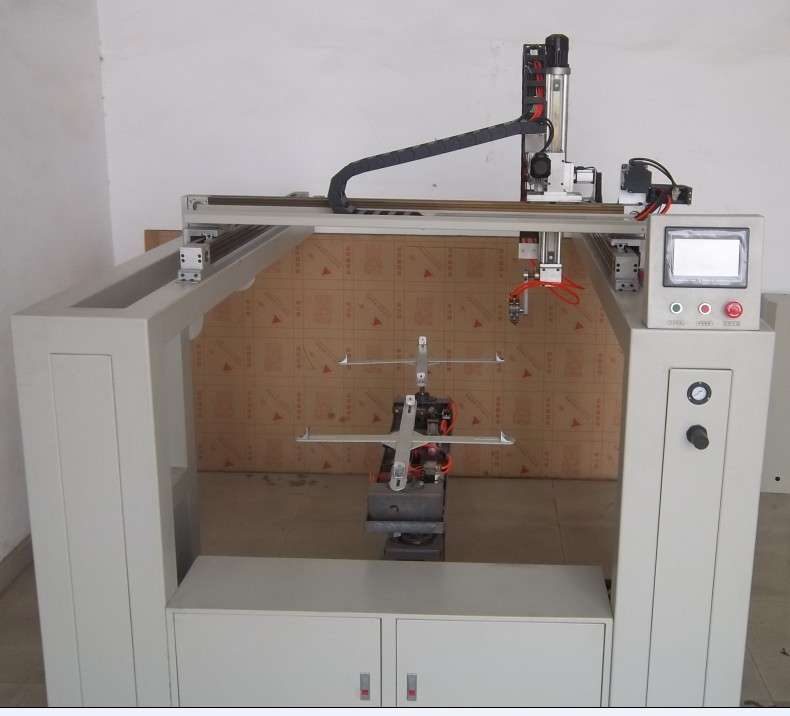
Three-axis movement covers parts whose faces sit at modest angles: the gun stays vertical while it travels the part's length, height and depth. Parts with deep undercuts or faces pointing in many directions belong on five-axis or six-axis machines instead. The standard build for this family is a compact machine of L1000 x W450 x H814 mm for the standard configuration; larger working envelopes are configured on request.
| Item | Value |
|---|
| Motion | X / Y / Z three-axis |
| Standard build size | L1000 x W450 x H814 mm |
| Control | Computer plus motion controller |
| Typical parts | Phone hardware, small housings, simple 3D parts |
When three axes are enough — and when they are not
If every surface you coat can be reached by a vertical gun, three axes are enough and the machine stays simple to program and maintain. The moment a face tilts beyond a modest angle, coating weight on that face falls off; that is the signal to price a five-axis machine instead. Send a drawing with the steepest face marked and we will make the call with you.
Service and warranty
This equipment is supplied with a 12-month warranty. Spare wear parts (guns, nozzles, filters, belts) are listed in the quotation so you can stock them at commissioning.
Application scope
Axis spray machines serve production where the same part repeats thousands of times: consumer electronics housings, helmets and protective gear, sanitary ware, toys and moulded plastic or metal components. The economic logic is repeatability — once the gun path, distance and speed are set for a part, every cycle repeats them, so film thickness stays even and paint consumption per part can be measured and tuned.
Two operating habits decide results more than the machine class does. First, fixture design: a part that sits 2 mm differently each cycle sprays differently each cycle. Second, gun maintenance: a worn nozzle changes the fan pattern long before it fails outright, so nozzle checks belong in the weekly routine. Both points are covered when a configuration is commissioned.
Pairing with booths and curing
An axis machine is one station in a process. Upstream, parts usually need cleaning or electrostatic dust removal, especially moulded plastics that carry static. Downstream, the coating decides the next step: air-dry paints need flash-off space, baked enamels need an oven, UV coatings need a curing section. When you request a quote, name the equipment you already own for these stages; the machine will be specified to feed it, including conveyor height and part hand-off.
What to send for a configured quotation
- Part drawings or photos, with the largest part size (L x W x H)
- Coating type and finish requirements (colour, gloss, film thickness if specified)
- Required output: parts per hour or per shift, and working hours per day
- Destination country and local power supply (voltage / frequency)
- Workshop space available for the machine or line, if a full line is planned
Buyer questions
Can it run two part types in one shift?
Yes, programs are stored per part. Fixture change is the limiting step, so tell us your changeover frequency.
Not sure which configuration fits?
Send your part drawings, part size and output target. We will confirm the machine or line configuration and reply with a quotation.
Send an Inquiry