Types of Robots Used in Spray Painting
Several types of robots serve spray painting applications, and each type suits different parts and production mixes. This guide compares the types and shows how to match a robot to your production.
Home › Types of Robots Used in Spray Painting
Several types of robots serve spray painting applications, and each type suits different parts and production mixes. This guide compares the types and shows how to match a robot to your production.
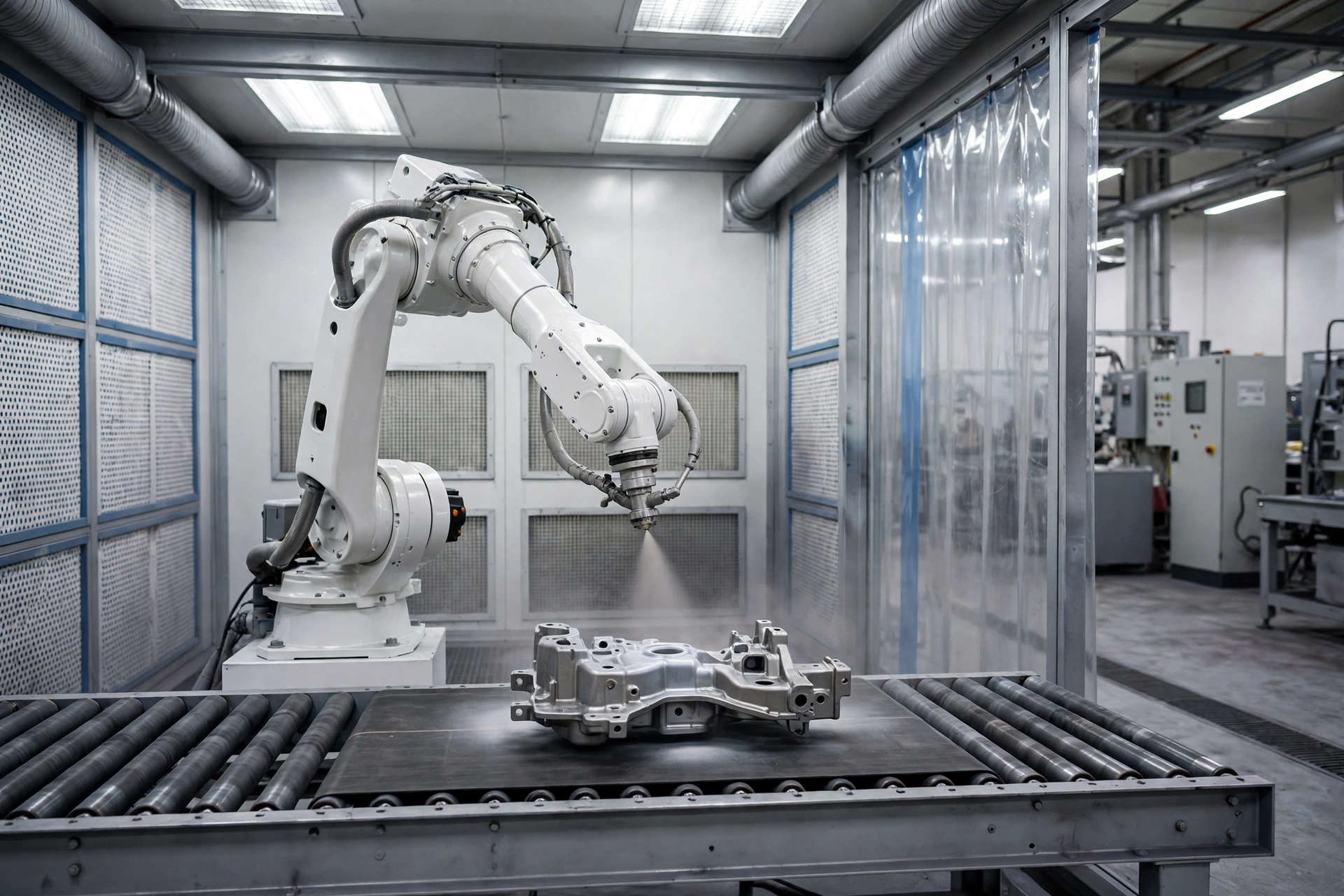
Six-axis articulated robots are the generalists: they reach around parts and reproduce hand-spraying motions. Cartesian (gantry) robots move on straight axes over large flat work such as doors and panels. Reciprocating systems with a rotating part presentation act like simple robots for round or symmetrical parts. Collaborative-style arms appear in small cells for light parts and low volumes, trading speed and reach for easy teaching.
| Robot type | Movement | Suits |
|---|---|---|
| Six-axis articulated | Full articulated arm | Complex 3D parts, mixed production |
| Cartesian / gantry | Straight X/Y/Z axes | Doors, panels, large flat work |
| Rotary presentation | Part rotates before fixed guns | Round and symmetrical parts |
| Small teachable arm | Compact articulated | Light parts, trials, low volume |
Start from your largest and most complex part: its reach envelope and orientation changes pick the robot class. Then check payload — gun, hoses and paint supply ride on the arm — and the booth size the robot's motion needs. Programs, fixtures and safety complete the cell; budget for them alongside the arm itself.
Robot comparisons usually stop at the arm, but the cell around it — booth size for the arm's envelope, extraction, safety fencing or scanning, and paint supply — is a large share of project cost and the part that decides whether the arm's theoretical reach is usable. Compare cell quotes, not arm quotes.
A door factory coating flat and moulded doors all day rarely needs a six-axis arm: a cartesian system travelling the door's length, with gun tilt for the mouldings, covers the work with simpler programming and easier maintenance. The same factory adding deep-drawn decorative panels with undercut edges crosses into articulated-robot territory, because the gun must change orientation continuously along the profile. The part list, read honestly, picks the robot type — not the other way round.
Mixed plants run both: gantry capacity for the flat volume, one articulated cell for the complex minority. If your production is 80 percent flat and 20 percent complex, ask for that split in the proposal rather than one robot type stretched across both jobs.
Send part drawings, coating type and output target through the inquiry page; the reply will confirm the configuration and quotation.
Send your part drawings, part size and output target. We will confirm the machine or line configuration and reply with a quotation.