Selective Conformal Coating Machine Guide
A selective conformal coating machine protects only the areas that need coating. This guide compares selective and full coating and explains the accuracy and valve choices behind a good setup.
Home › Selective Conformal Coating Machine Guide
A selective conformal coating machine protects only the areas that need coating. This guide compares selective and full coating and explains the accuracy and valve choices behind a good setup.
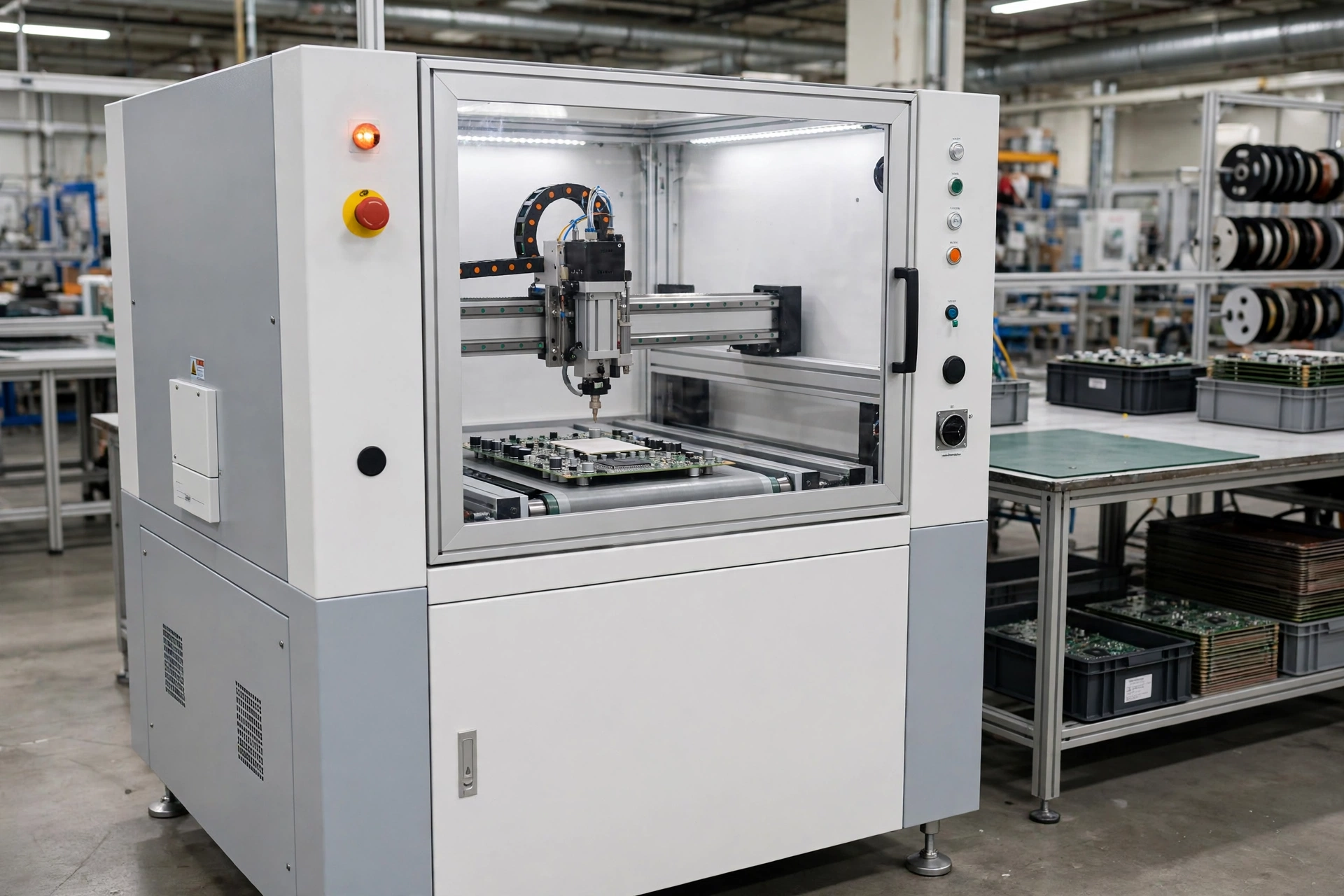
Full coating covers the whole board (by dip, spray or curtain) and then pays for it in masking: connectors, test points and heat sinks must be masked before and unmasked after. Selective coating programs the coated areas and leaves keep-outs bare, removing masking labour and its defects. Boards with many keep-outs gain most; simple boards with none may not need selectivity at all.
Keep-out margins are an accuracy question: the tighter the margin, the better the motion system and valve control must be. Spray valves lay film fast over open areas; needle valves draw precise borders. Production machines combine both, spraying fields and edging with the needle. When you request a quote, state your smallest keep-out margin — it decides the machine class more than board size does.
Selective coating moves work from the production line to the programmer: the coating pattern is taught from the board design, checked on first articles and then frozen. Factories that treat pattern approval as a formal step — signed first-article boards, versioned programs — avoid the commonest selective-coating dispute, which is a pattern that quietly drifted from the approved one.
Selective coating is not automatically superior. Boards with no keep-out areas, low volumes, or coatings that must encapsulate component bodies can be cheaper to coat fully — by dip or curtain — with minimal masking. Prototype and repair work also stays manual in most factories, because programming a selective pattern for ten boards costs more than coating them by hand. The decision rule is volume times keep-outs: as either grows, selective takes over.
A hybrid is common in larger plants: selective machines run production boards, while a small manual station handles prototypes and rework. If that is your shape, say so in the inquiry — the production machine's specification should not be inflated to cover work it will never see.
Send part drawings, coating type and output target through the inquiry page; the reply will confirm the configuration and quotation.
Send your part drawings, part size and output target. We will confirm the machine or line configuration and reply with a quotation.